Automating Google reviews and repeat purchases
How Malaysian SMEs automate Google review requests and repeat-purchase reminders with WhatsApp and a CRM, within Google's rules and the PDPA.
To automate Google reviews, trigger one review request from your CRM when a job is marked done or an invoice is paid, send it on WhatsApp or email with your Google review link, and send one reminder at most. Ask every customer, not only happy ones, and never offer a discount for a review, because Google's policy forbids both. Repeat purchases work the same way: a reminder timed to the product's natural cycle, sent only to customers who agreed to marketing messages.
Part of the guide: Marketing automation
On this page
You can automate Google reviews and repeat purchases with the same three parts: a trigger in your CRM (job done, invoice paid, product delivered), a message on WhatsApp or email with the right link, and a stop rule. The two things that get businesses into trouble are asking only happy customers and paying for reviews with discounts. Both break Google's policy. Below is the flow we build, with timing, message examples and costs.
Prepared 9 November 2026. Part of our guide to marketing automation in Malaysia. Google and Meta rules as published on their help pages, checked on the same date.
Why automate review requests at all?
Most SMEs ask for reviews the same way: a staff member remembers, sometimes, at the counter or at the end of a call. The customers who get asked are the friendly regulars. The ones who had a good but ordinary experience, the majority, are never asked and never write anything.
An automated request fixes the "sometimes". It goes out after every completed job, at the same point in the customer journey, without anyone remembering. In the setups we build, the review request is a branch of the same follow-up system that answers new leads, so it costs little extra once the CRM and WhatsApp connection exist. If you are not there yet, start with our lead follow-up sequence from day 0 to day 30.
What do Google's rules allow?
Google's rules sit in two places: the Maps user-generated content policy and the Business Profile help page on getting more reviews.
| Allowed | Not allowed |
|---|---|
| Asking customers to leave a review through a Google link or QR code | Selectively soliciting positive reviews from customers |
| Sending the same request to every customer automatically | Discouraging or prohibiting negative reviews |
| A reminder if the customer has not reacted | Offering payment, discounts, free goods or services for a review, a changed review or a removed review |
| Replying to every review, good or bad | Asking staff to collect a set number of reviews or reviews with specific content |
| A private feedback form offered to everyone | Reviews by current or former employees (conflict of interest) |
The most common mistake we see in Malaysian businesses is the "lucky draw for reviewers" or "10% off your next visit if you review us". Google lists exactly this kind of incentive as prohibited. Reviews collected that way can be removed, and the profile can be restricted.
How does an automated review flow work?
The flow has five steps. Each one is a rule in the CRM or the automation tool, not a person's job.
- Trigger. The job status changes to "completed", an invoice is marked paid, or the courier confirms delivery.
- Wait. A delay that matches the business: same evening for a service visit, two to five days after delivery for a product, so the customer has used it.
- Request. One message on the channel the customer already uses with you, usually WhatsApp in Malaysia, otherwise email. It names the order or visit and contains your Google review link.
- Reminder. If the link has not been clicked after three days, one short reminder. Then the flow stops for that order.
- Response routing. New Google reviews land in a shared inbox or channel. Anything with three stars or fewer creates a task for a manager to reply within one working day.
The private feedback form, if you want one, goes into step 3 for everyone: "Tell us how we did" and "Review us on Google" side by side. What you must not build is a step that asks "Were you happy?" first and only shows the Google link to people who answer yes.
For businesses with many outlets or reviews across Google, Facebook and delivery apps, the next step is routing review themes to operations. Our guide to customer feedback loops for F&B and retail covers that part, and what we set up for outlets is on AI for food and retail businesses.

What should the message say?
Short, specific to the order, no promotion. A WhatsApp example we use as a starting point:
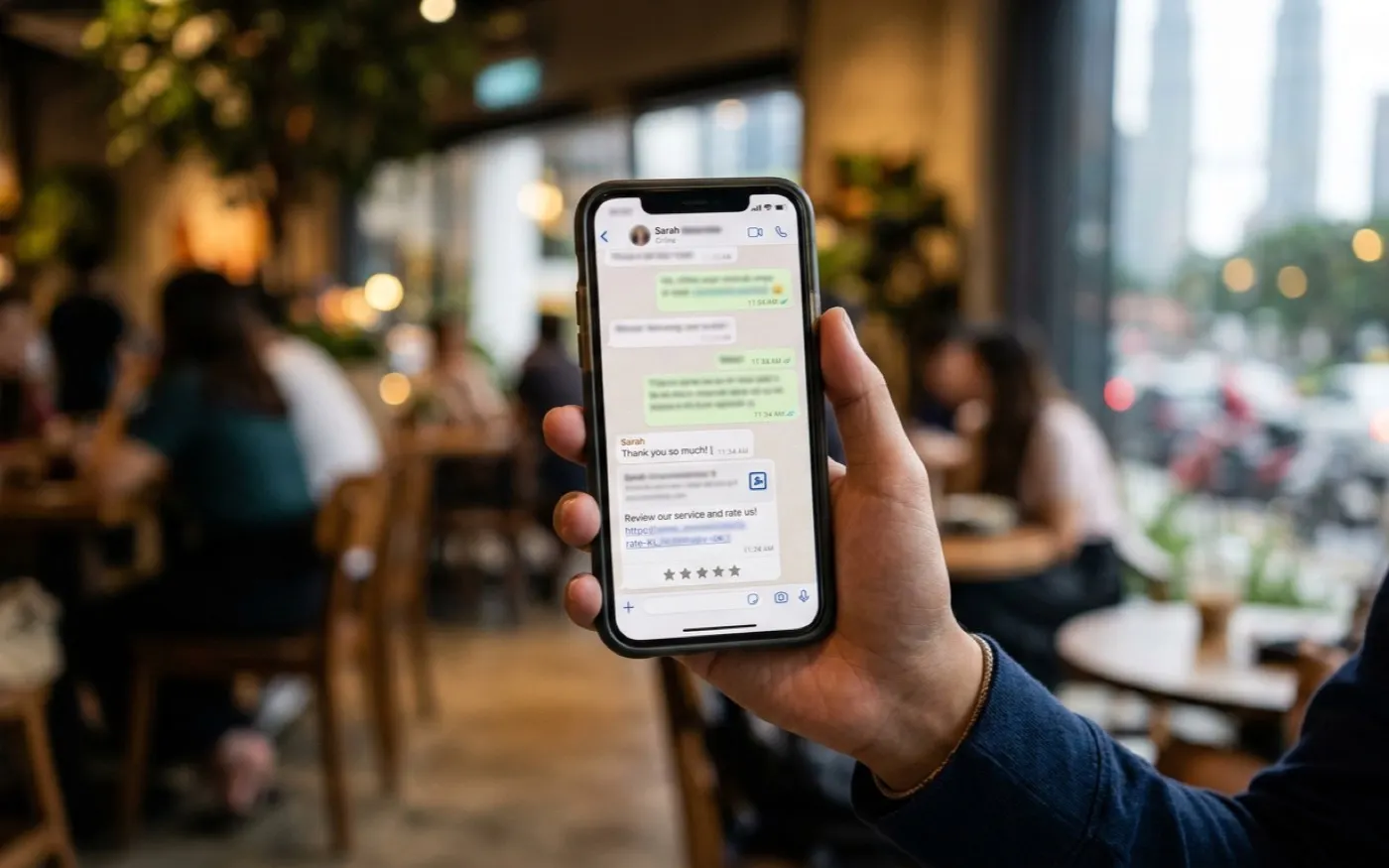
Hi Aisyah, thank you for choosing us for your aircon service on 4 Nov. If you have a minute, a review on Google helps other families in Shah Alam find us: [review link]. If anything was not right, just reply here and our supervisor will call you.
This keeps the message to one order and one request, which matters for WhatsApp. Meta's template rules say a feedback request can be approved as a utility template when it relates to a specific order or interaction and contains no promotional content. Add "and get 10% off your next booking" and it becomes a marketing message, with marketing pricing, the need for marketing opt-in and, for Google reviews, a policy breach on top.
Write the template in the language your customers use with you. Many Malaysian businesses run Bahasa Malaysia and English versions and pick the one stored on the contact.
How do you automate repeat purchases?
Repeat purchases use the same trigger logic with a longer delay. The key is the natural cycle of what you sell: when would a customer need it again without being pushed?
| Business | Typical cycle | Trigger | Message |
|---|---|---|---|
| Aircon servicing | 4 to 6 months | Last service date | "Your units are due for servicing" with two time slots |
| Water filter, coffee beans, pet food | Usage-based, often 1 to 3 months | Delivery date plus usage estimate | Reorder link with the last order prefilled |
| Car workshop | By mileage or 6 months | Last service date and mileage | Service reminder with booking link |
| Clinic, salon, dental | Treatment plan or 6 months | Last appointment | Booking reminder from the same person who treated them |
| B2B consumables | Order history average | Days since last order passes the average | Personal message from the account manager |
Unlike the review request, a repeat-purchase reminder is direct marketing. Under section 43 of the Personal Data Protection Act 2010, a person can tell you at any time to stop using their data for direct marketing, so send these only to contacts with a recorded marketing consent and stop at once when they opt out. Our article on email marketing automation and PDPA consent shows how to store that consent and sync opt-outs across email, CRM and WhatsApp. General information, not legal advice.
Example: a service business in Klang
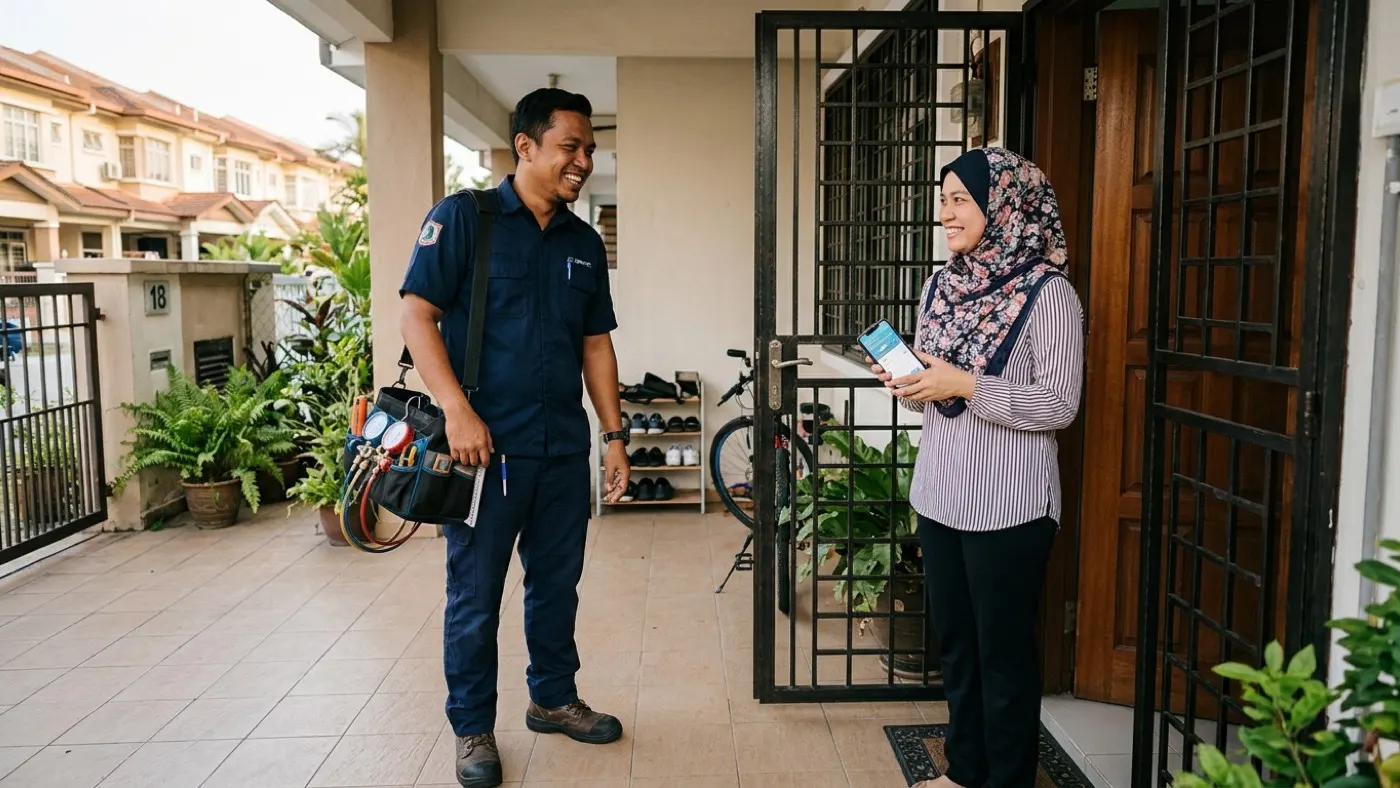
Illustrative example, not a client case. An aircon servicing company with four teams completes around 300 jobs a month. Today the technicians are told to "ask for reviews", and the profile gets a handful a month, mostly from regulars. The new setup: when the technician closes the job in the CRM app, a utility WhatsApp template goes out at 7 pm that evening with the review link and a reply option for complaints. One reminder follows three days later. Five months after the service, customers who ticked the marketing box receive a servicing reminder with two booking slots; customers who did not tick it receive nothing. Every review with three stars or fewer creates a call task for the operations manager. Nobody gets a discount for reviewing.
Which tools do you need?
You need three things that talk to each other: a CRM that holds the order or job status, a WhatsApp Business Platform connection (the API, not the phone app) and an email tool for customers without WhatsApp. HubSpot, Zoho and Pipedrive can all run these triggers; our guide on choosing a CRM for a Malaysian SME compares them. Where your job or order data lives in an accounting or POS system, a workflow tool such as n8n or Make moves the "completed" status into the CRM.
What does it cost?
The review flow and the repeat-purchase reminders together count as one automation in our price list: MYR 12,000 to 25,000 for the build, depending on how many systems hold your order data and how many outlets you run. Most builds start with a Quick Scan audit from MYR 3,500, credited to the build. Running costs are your CRM subscription, WhatsApp message fees charged by Meta per template category, and an optional care plan from MYR 2,500 a month after go-live. Our breakdown of marketing automation cost in Malaysia explains each block.
Checklist: review and repeat-purchase automation
- Trigger tied to a real event: job completed, invoice paid or delivery confirmed
- Delay that matches when the customer has experienced the result
- Same review request for every customer, no satisfaction filter before the Google link
- No discount, voucher, lucky draw or gift linked to reviews
- Message names the specific order or visit, no promotion in a utility template
- One reminder at most, then stop for that order
- Low-star reviews create a task for a named person, reply within one working day
- Repeat-purchase reminders only to contacts with recorded marketing consent
- One opt-out field respected by every flow
- Monthly check: requests sent, links clicked, new reviews, repeat orders from reminders
If your team should run and adjust these flows itself, our AI courses include hands-on work with CRM and WhatsApp automation. To have the system built for you:
Plan your review and repeat-purchase automation
Sources
- Google, Maps User Generated Content Policy, Prohibited and restricted content (rating manipulation, incentives, conflict of interest), checked 9 November 2026.
- Google Business Profile Help, Tips to get more reviews, checked 9 November 2026.
- Meta for Developers, WhatsApp template categorization (feedback surveys as utility templates), checked 9 November 2026.
- Personal Data Protection Act 2010 (Act 709), section 43 (direct marketing), Laws of Malaysia. Official information: pdp.gov.my.
- winsym.ai prices from our current offer list (Quick Scan from MYR 3,500; one automation MYR 12,000 to 25,000; care plan from MYR 2,500 per month), as of November 2026.
Frequently asked questions
Is it allowed to automate Google review requests?
Yes. Google's own Business Profile help suggests asking customers to visit a Google link or scan a QR code. What Google forbids is selectively soliciting positive reviews, discouraging negative ones, and offering incentives such as payment, discounts or free goods in exchange for a review.
Can I send unhappy customers to a private form and happy ones to Google?
No. Filtering customers so that only satisfied ones are asked for a Google review is selective solicitation under Google's Maps content policy. You can offer a private feedback form, but every customer must receive the same invitation to review on Google.
Is a WhatsApp review request a utility or marketing message?
Meta can approve a feedback request as a utility template if it refers to a specific order or interaction and contains no promotion. A generic request or one that mentions an offer is treated as marketing, which is priced differently and needs marketing opt-in.
When is the best time to ask for a review?
Shortly after the customer has experienced the result: the same day for a service visit or a meal, two to five days after delivery for a product. Our default is one request plus one reminder three days later, then stop.