AI and Job Losses in Malaysia 2026: What the Statistics Actually Show
Is AI taking jobs in Malaysia? 42,807 job losses in 2026, up to 697,000 roles at risk, and 66% of young graduates underemployed. Seven verified numbers.
The data does not yet prove that AI is behind Malaysia's job losses. 42,807 people lost their jobs between January and 12 June 2026, two in five of them through closures and downsizing. But a study of PERKESO records finds about 69% more job losses in the most AI-exposed occupations, up to 697,000 jobs could be significantly affected within three to five years, and 66% of graduates aged 24 and below already work below their qualification.
Part of the guide: Executive AI Coaching in Malaysia: The Complete Guide (2026)
On this page
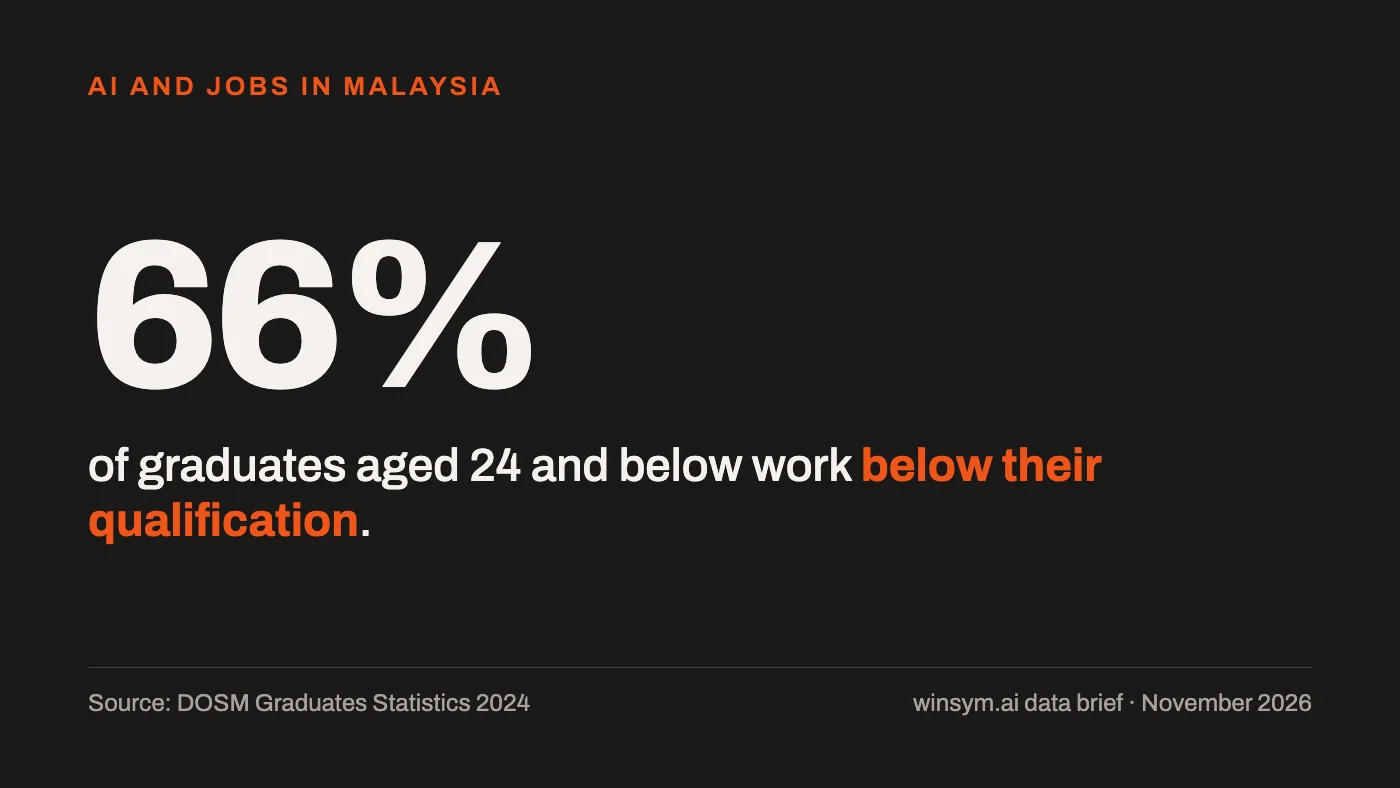
Is AI taking jobs in Malaysia? The data does not prove it yet. But the group with the most to lose was already struggling: 66% of graduates aged 24 and below work below their qualification, and that was before AI started doing junior work.
This data brief checks the published figures against their sources and puts the seven that matter in one place. Every number links to where it comes from. Figures marked derived are our own arithmetic from two published numbers.
Seven numbers on AI and jobs in Malaysia
| # | Number | What it means | Source |
|---|---|---|---|
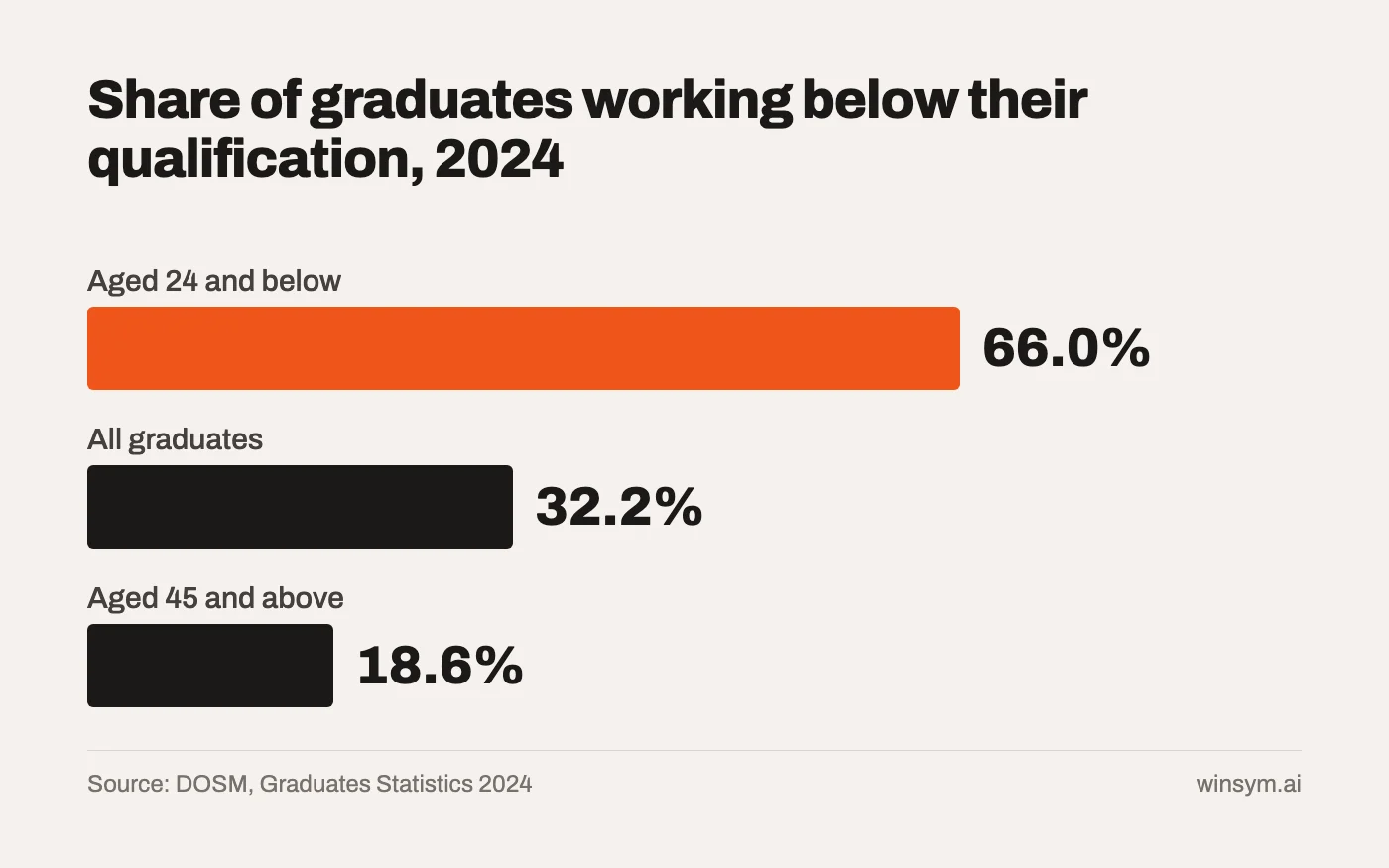
| 1 | 66% | Of graduates aged 24 and below work below their qualification (2024). For graduates aged 45 and above it is 18.6%. | [1] |
| 2 | 3.2% | Graduate unemployment. The problem is the wrong job, not no job: 1.60 million graduates, 32.2%, are underemployed. | [1] |
| 3 | 42,807 | People lost their jobs between January and 12 June 2026, about 263 a day (derived). Closures and downsizing made up 40.85%. | [2] [3] |
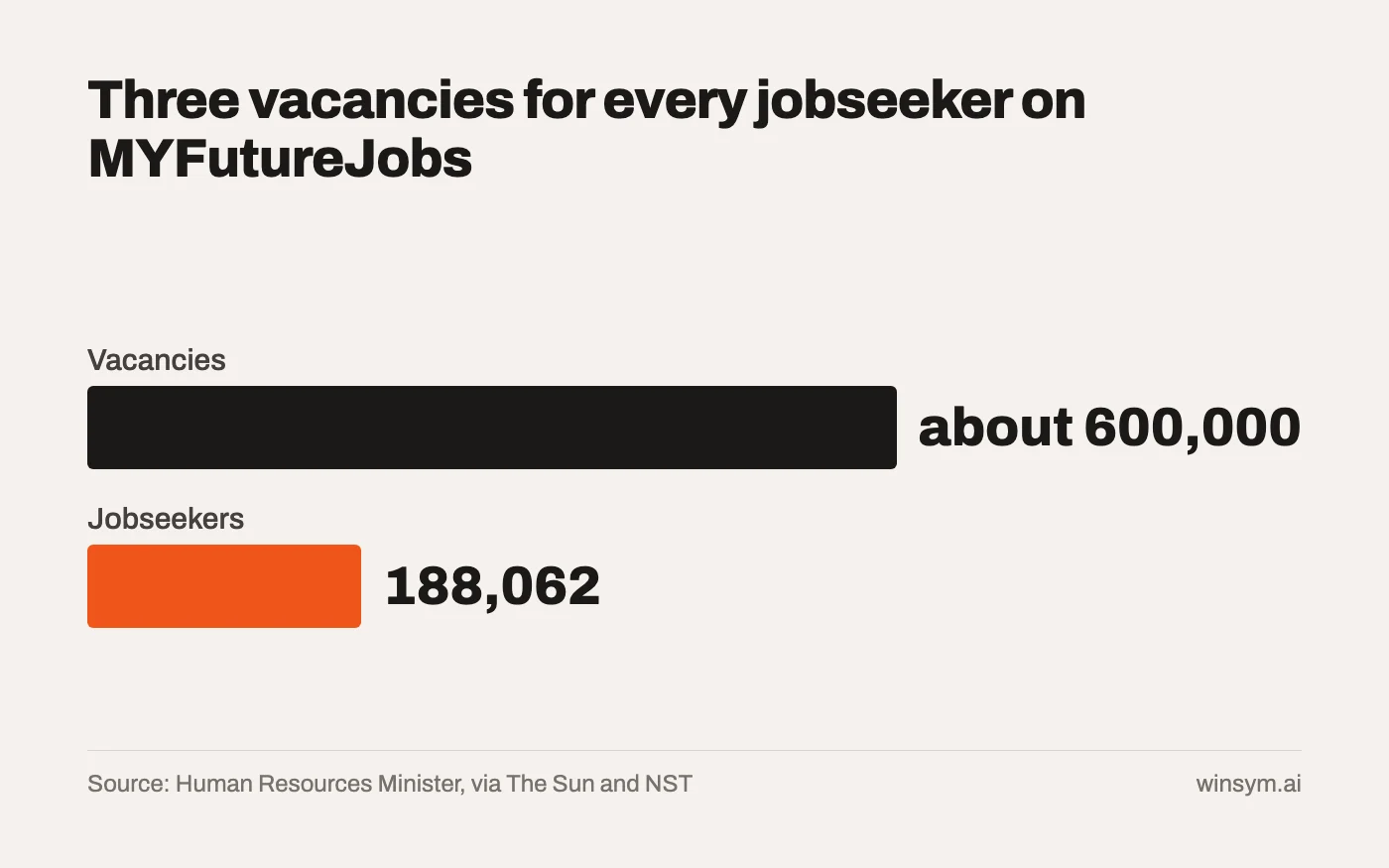
| 4 | 3 to 1 | About 600,000 vacancies against 188,062 jobseekers on MYFutureJobs (derived). Still only about 33% of those who lost their jobs found work through it. | [2] [3] |
| 5 | 697,000 | Jobs that could be significantly affected within three to five years without reskilling, cited in June 2026. In 2024 the figure was 620,000. | [4] [5] |
| 6 | 69% | More job losses in the most AI-exposed occupations than the average, in a study of PERKESO records. | [6] |
| 7 | 28% | Of Malaysia's labour force is highly exposed to generative AI, more so among women, younger and tertiary-educated workers. | [6] |
Is AI the reason people are losing jobs?
There are two official readings of the same year. The Human Resources Minister told Parliament in June that the data does not support AI as the driver [7]. An ISIS Malaysia study of PERKESO loss-of-employment records finds the losses concentrated where AI exposure is highest: around 69% more than average in the most exposed occupations, and about 1.5 times the average where AI replaces tasks rather than supports them [6]. Claims have roughly tripled since 2022 [7].
Both can be true. Closures and downsizing alone explain two in five cases today, while the pattern inside the data is starting to tilt towards AI-exposed work. The honest answer is that it is too early to say for sure.
One more thing most headlines skip: "at risk" is not "gone". The 620,000 and 697,000 figures are projections of jobs that will change or be displaced if workers do not reskill. They are not a count of jobs lost.
Why fresh graduates feel it first
The entry-level squeeze came before AI. Two in three young graduates were already underemployed in 2024, while the median graduate salary stood at RM4,521 a month [1]. AI lands on top of that. The tasks it does best, drafting, summarising, basic analysis, are exactly the tasks juniors used to learn on. Fresh grads now describe a catch-22: no experience, no job, and fewer starter roles to get the experience [8].
"I meet graduates who did everything right. Good degree, good results, and now they are keying in data all day. That was true before ChatGPT. AI did not create this problem, it just took away the excuse to ignore it." Karim Azzaoui, founder of winsym.ai, Kuala Lumpur
"A boss who deletes the junior roles today is deleting his own future managers. Do not delete the junior job. Redesign it." Karim Azzaoui
The real story is the mismatch
Three vacancies for every jobseeker, and still most retrenched workers do not land a job through the national portal [2]. That is a skills problem. Skills problems can be fixed, and Malaysian employers have already paid for the fix through the HRD Corp levy.
What to do with this
- Fresh grads: learn to work with AI tools in your own field and show it in your portfolio. The share of job postings asking for AI skills went from 1.9% in 2024 to 4% in 2025 [9]. Start with our guide to AI skills for fresh graduates.
- Employers: do not cut junior roles because AI can do the junior tasks. Redesign them so juniors check, improve and own what the AI drafts.
- HR teams: your levy is already paid. Use it for AI upskilling through HRD Corp claimable courses before the squeeze reaches your people. Your own department can start with AI training for HR teams in Malaysia.
- Leaders: decide which roles change first and what you will do with the time saved. That is the work we do in executive AI coaching and in the AI Strategy for Leaders course.
- Parents: the degree still matters. But ask what the course teaches about working with AI, not only the ranking.
Method and limits
- This is an analysis of published figures, not a survey. Sources: DOSM, the Human Resources Ministry and PERKESO as reported by the named news outlets, TalentCorp, ISIS Malaysia, and PwC as reported by The Star.
- Every figure was pulled from the source page and checked word for word by script. Research date: 17 November 2026.
- Graduate figures are for 2024, the latest DOSM Graduates Statistics we could load.
- Vacancy counts differ slightly between reports (600,168 in The Sun, 605,168 in NST), so we say "about 600,000".
- The 697,000 and 620,000 figures cover selected sectors and depend on TalentCorp's own definition of "impacted".
- The ISIS study shows a correlation between AI exposure and job-loss claims, not proof that AI caused them.
- The PwC figures are cited as reported by The Star; we did not load the PwC report itself.
The longer research edition with the full fact table is available as a PDF: AI and jobs in Malaysia.
Sources
- DOSM, Graduates Statistics 2024
- Human Resources Minister, reported by NST, June 2026
- Human Resources Minister, reported by The Sun
- Human Resources Minister, reported by Malay Mail, 24 June 2026
- TalentCorp, impact study
- ISIS Malaysia, New AI technologies and employment outcomes in Malaysia, 10 June 2026
- BusinessToday, 4 October 2026
- Malay Mail, 1 November 2026
- PwC 2026 Global AI Jobs Barometer for Malaysia, reported by The Star, 6 September 2026
Journalists and researchers: you are free to use these figures with a link to this page as the source. For charts or comment, book a free 30-minute call.
Frequently asked questions
Is AI causing job losses in Malaysia?
Not provably, yet. The Human Resources Minister told Parliament in June 2026 that the data does not support AI as the driver. An ISIS Malaysia study of PERKESO records finds around 69% more job losses in the most AI-exposed occupations. Closures and downsizing alone account for two in five cases.
How many people lost their jobs in Malaysia in 2026?
42,807 people between January and 12 June 2026, according to the Human Resources Minister. Business closures and company downsizing accounted for 17,485 of those cases, or 40.85%.
How many jobs in Malaysia are at risk from AI?
Up to 697,000 jobs could be significantly affected by AI, digitalisation and the green economy within three to five years if workers do not upgrade their skills, the minister said in June 2026. The TalentCorp study launched in 2024 put the figure at 620,000. Both are projections, not counted losses.
How many Malaysian graduates are underemployed?
1.60 million graduates, or 32.2%, worked below their qualification in 2024, according to DOSM. For graduates aged 24 and below the rate was 66.0%. Graduate unemployment was 3.2%.
What can fresh graduates do about AI and jobs?
Learn to use AI tools inside your own field and show it in your portfolio. The share of job postings in Malaysia asking for AI skills rose from 1.9% in 2024 to 4% in 2025, according to PwC.