AI training for HR teams in Malaysia: syllabus, tools, PDPA and cost
What generative AI training for an HR team in Malaysia should cover: tasks, PDPA rules for staff data, a one-day syllabus, HRD Corp claim steps and real prices.
AI training for an HR team in Malaysia should teach three things in order: which staff and candidate data may go into which tool under the PDPA, the HR tasks where AI saves time (job ads, policy FAQs, onboarding, interview guides), and a review routine that keeps decisions about people with people. A one-day in-house class for up to 20 costs MYR 8,500 to 10,000 with us.
Part of the guide: AI Training in Malaysia for Companies: Courses, Costs and Providers (2026)

On this page
- The short answer
- Why does HR need its own AI training?
- Which HR tasks are worth training on?
- What must HR know about PDPA before using AI?
- What a one-day AI course for HR looks like
- What does AI training for HR cost in Malaysia?
- How do you claim the course from HRD Corp?
- What can a large company's HR AI rollout teach an SME?
- How we run it at winsym.ai
- Sources
- Frequently asked questions
HR is usually the team that is asked to roll out AI to everyone else, and the team with the least room for mistakes. It writes the AI usage policy, organises the training budget and handles the most sensitive data in the company: salaries, medical certificates, disciplinary notes, IC numbers. A generic ChatGPT course does not prepare an HR officer for any of that.
This page sets out what generative AI training for an HR team in Malaysia should contain, which rules apply to staff data, how a one-day class runs, and what it costs including the HRD Corp claim.
Part of the guide: AI training in Malaysia for companies. Prices from our own price list, November 2026. Rules checked 12 November 2026.
The short answer
Teach HR in this order: data rules first, tasks second, checks third. HR people pick up the tools quickly. What they need from a course is a clear line on what may go into which tool, a handful of HR tasks they will repeat every week, and a review habit that keeps every decision about a person with a person.

Why does HR need its own AI training?
Three reasons set HR apart from the rest of the company.
- The data is personal by default. Almost every HR document names someone. Under the Personal Data Protection Act 2010 (Act 709), candidate and employee information is personal data, and the company stays responsible for it when a tool processes it.
- HR decides about people. Hiring, promotion, warnings and dismissals have legal and human consequences. In April 2026 the Personal Data Protection Department introduced guidelines on Data Protection Impact Assessment, Data Protection by Design and Automated Decision-Making and Profiling; the commissioner described the approach as keeping human elements to avoid bias (The Star, 30 April 2026, checked November 2026).
- HR owns the rollout. The usage policy, the training plan and the HRD Corp grant usually sit with HR. A team that has used AI on its own work writes a better policy than one that copied a template.
The broader comparison of HR, finance, sales and marketing is in AI training for HR, finance, sales and marketing teams. This article goes deeper on HR only.
Which HR tasks are worth training on?
We pick tasks that come up every week, where a draft saves time and a person still checks the result. These are the ones we use in class:
| HR task | What AI does | What the HR officer checks |
|---|---|---|
| Job descriptions and job ads | Drafts from a role brief, in the company's tone, in English and Bahasa Malaysia | Requirements are real, no discriminatory wording, salary range correct |
| Policy into staff FAQ | Turns a 10-page policy into questions and short answers | Every answer traced back to a clause |
| Onboarding pack | Builds a first-week plan and welcome email from a checklist | Dates, names, systems and contacts |
| Interview question bank | Writes competency-based questions and a scoring guide | Questions are job-related and the same for every candidate |
| Engagement survey comments | Groups anonymised comments into themes with counts | Sample of comments read in full; no names in the input |
| Letters and memos | Drafts confirmation letters, reminders, memos | Legal wording and figures against the template |
| Training needs summary | Summarises appraisal notes into training themes | Identifiers removed first; final plan is HR's own |
What we leave out on purpose: ranking candidates, deciding who is promoted, drafting a dismissal decision, and anything that needs medical information. AI can help prepare the paperwork around these, but the decision and its reasons stay with a person.
What must HR know about PDPA before using AI?
This is the first module, not the last. The rules we teach are practical, not legal theory:
- Approved account only. A company ChatGPT Team or Enterprise, Microsoft 365 Copilot or Gemini for Workspace account, never a personal free account. Our guide on PDPA and AI in Malaysia explains the difference.
- Remove what the task does not need. Names, IC numbers, addresses, bank details and phone numbers come out before the text goes in. A survey theme analysis does not need to know who wrote the comment.
- Keep sensitive data out. Health information, which includes medical certificates, belongs to the sensitive categories under the Act. Salary and disciplinary records stay out of general-purpose tools.
- Know the vendor questions. Malaysia's draft framework on AI and personal data, put to public consultation on 5 October 2026, expects organisations to do due diligence before buying third-party AI, set responsibilities in contracts and keep overseeing the vendor (Baker McKenzie summary, October 2026, checked November 2026). HR often signs off HR software, so this matters.
- Know who your DPO is. After the 2024 amendments, many companies must appoint a Data Protection Officer; registration runs through the Personal Data Protection Department. Whether your company is in scope is covered in do you need a data protection officer.
This is an explanation of published rules, not legal advice.
What a one-day AI course for HR looks like
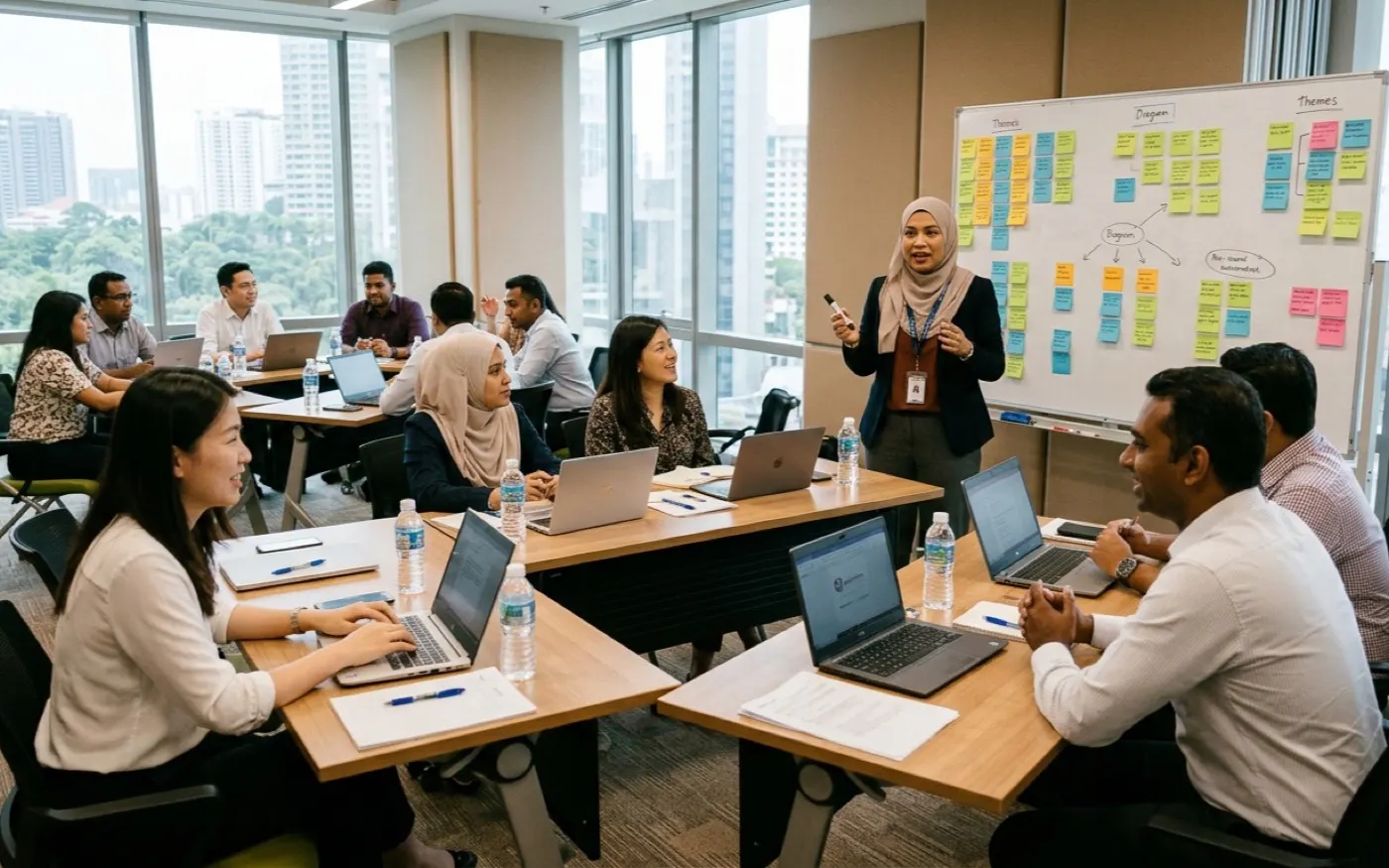
This is the day we run for HR teams, adapted from our Generative AI at Work course, whose audience already includes admin, HR, finance and customer service staff. Participants bring a laptop and one recurring task from their own job.
| Time | Module | Output |
|---|---|---|
| 09:00 | How AI tools work and where they fail; ChatGPT, Copilot, Gemini and Claude compared for HR work | A tool choice per HR task |
| 10:15 | Data rules in practice: anonymise a real-looking HR document and decide which tool it may go into | A one-page "what goes in" sheet for the team |
| 11:30 | Writing tasks: job ad, policy FAQ, onboarding email in your company's voice | Three drafts plus a review checklist |
| 13:30 | Documents and data: survey comments into themes, appraisal notes into training needs | A summary checked against the source |
| 15:00 | Your company's AI usage policy: HR drafts the first version | A policy draft ready for management |
| 16:00 | Capstone: each participant rebuilds their own task and shows before and after | One task per person, documented |
The capstone matters most. A participant who leaves with a working version of their own weekly task is the one still using it a month later. Why most training fades without that, and what helps, is in why AI training fades.
What does AI training for HR cost in Malaysia?
Our prices are per group of up to 20 people, not per head, from our own price list (November 2026):
| Format | Price per group | HRD Corp cost cap |
|---|---|---|
| Half-day workshop | MYR 4,500 to 5,500 | RM6,000 per half day |
| Full-day course with capstone | MYR 8,500 to 10,000 | RM10,500 per group per day |
| Two-day course with an automation build | MYR 16,000 to 19,000 | RM10,500 per day, two days |
| Seat in a public class | MYR 890 to 1,190 per person | RM1,750 per person per day |
An HR team of six usually fits best in a public class or joins a company-wide in-house day. A larger HR function, or HR plus line managers, makes an in-house day cheaper per person. More price comparisons are in AI training cost in Malaysia.
How do you claim the course from HRD Corp?
HR files the grant in e-TRiS under HRD Corp Claimable Courses. The HRD Corp Support Centre (checked November 2026) lists the documents: the quotation, the trainer's profile and the schedule or course content. It also states that employers with outstanding levy and interest cannot apply.
Three rules decide whether the money comes back:
- Wait 14 days. In-house training starts at least 14 calendar days after the grant is approved (Employer's Circular 2/2026).
- Do not change the grant. Since Employer's Circular 2/2026, dates and participants cannot be edited after approval; a change means a new application.
- Attendance of 75%. Each trainee must attend at least 75% of the training time to count (HRD Corp Support Centre, claim reimbursement factors).
The full sequence is in how to claim HRD Corp for AI training, and the mistakes to avoid are in why HRD Corp claims get rejected.
What can a large company's HR AI rollout teach an SME?
IBM is the most cited example. Its HR assistant AskHR handles 94% of employee queries and about 10.1 million interactions a year, according to IBM's Chief Human Resources Officer Nickle LaMoreaux in Fortune (July 2024), checked November 2026. The figures are IBM's own.
The useful part for a Malaysian SME is the lesson behind them. When AskHR launched in 2017, almost nobody used it. When IBM made it mandatory in 2018, HR's net promoter score fell to minus 35, Fortune reports. Usage came once IBM asked managers what they needed, built that, and kept sensitive matters such as misconduct with HR people. Training is the same: start from the tasks your team already does, do not force a tool on them, and keep people in charge of decisions about people.
How we run it at winsym.ai
winsym.ai is an HRD Corp Registered Training Provider. Our HR classes are built on the participants' own tasks, and we prepare the HRD Corp documentation for the grant: course outline, trainer profile and schedule. The usage policy that HR drafts in class is theirs to keep and adapt.
See the Generative AI at Work course, or book a free 30-minute call and tell us how many people are in your HR team and which tools you already pay for. We will suggest the smallest format that works and tell you whether it fits your HRD Corp balance.
Sources
- Personal Data Protection Department (JPDP), Personal Data Protection Act 2010 (Act 709) and DPO registration guide, checked 12 November 2026.
- The Star, JPDP rolls out new guidelines to strengthen data protection, including AI use, 30 April 2026 (DPIA, DPbD and ADMP guidelines).
- Baker McKenzie, Malaysia: consultation on proposed AI and personal data protection framework, October 2026.
- HRD Corp Support Centre, HRD Corp Claimable Courses scheme: steps to apply grant, checked 12 November 2026. Employer's Circular 2/2026 (14-day rule), HRD Corp Allowable Cost Matrix (cost caps).
- Fortune, IBM's CHRO on lessons from its AI chatbot rollout, 12 July 2024.
- winsym.ai prices and course outline: our own price list and the Generative AI at Work syllabus, November 2026.
This page explains published rules and our own course design. It is not legal advice. Confirm current HRD Corp rules in e-TRiS and PDPA questions with your DPO or counsel.
Frequently asked questions
What should AI training for HR teams cover?
Data rules first (what may be pasted, what must be anonymised, which account to use), then HR tasks such as job descriptions, policy FAQs, onboarding material, interview question banks and survey summaries, and finally a review routine. Each participant should leave with one real HR task rebuilt with AI.
Can HR use ChatGPT or Copilot with employee data in Malaysia?
Employee and candidate information is personal data under the Personal Data Protection Act 2010, and the employer stays responsible for it when a tool processes it. Use only a company-approved account, remove identifiers such as names and IC numbers when the task does not need them, and keep health, salary and disciplinary details out of public tools.
Can AI screen CVs or make hiring decisions?
AI can help structure or summarise applications, but a person should make and be able to explain every decision about a candidate or employee. The Personal Data Protection Department's guideline on automated decision-making and profiling (April 2026) stresses transparency, fairness and keeping a human involved.
Is AI training for HR claimable from HRD Corp?
Yes, if the course is run by an HRD Corp Registered Training Provider under HRD Corp Claimable Courses and your company has enough levy balance; fees above the cost caps are not covered. For in-house training the course must start at least 14 calendar days after the grant is approved (Employer's Circular 2/2026).
How long should an AI course for HR be?
Half a day is enough for safe use and three core tasks. A full day adds a capstone on a real HR task and a draft AI usage policy for the company, which HR usually owns. Two days suit teams that also want to automate a workflow, such as onboarding.